Essential Florence
Michelangelo, the Medici, and the birth of the Renaissance
Benvenuti al Rinascimento
Florence packs more masterpieces into a few square blocks than most countries have in total. This is our cheat sheet for the museums, churches, and landmarks on our itinerary: what we’re seeing, why it matters, and how to make the most of it. Read up before we go, or pull it up on your phone while we’re standing in front of the real thing.
The Great Galleries
Bargello
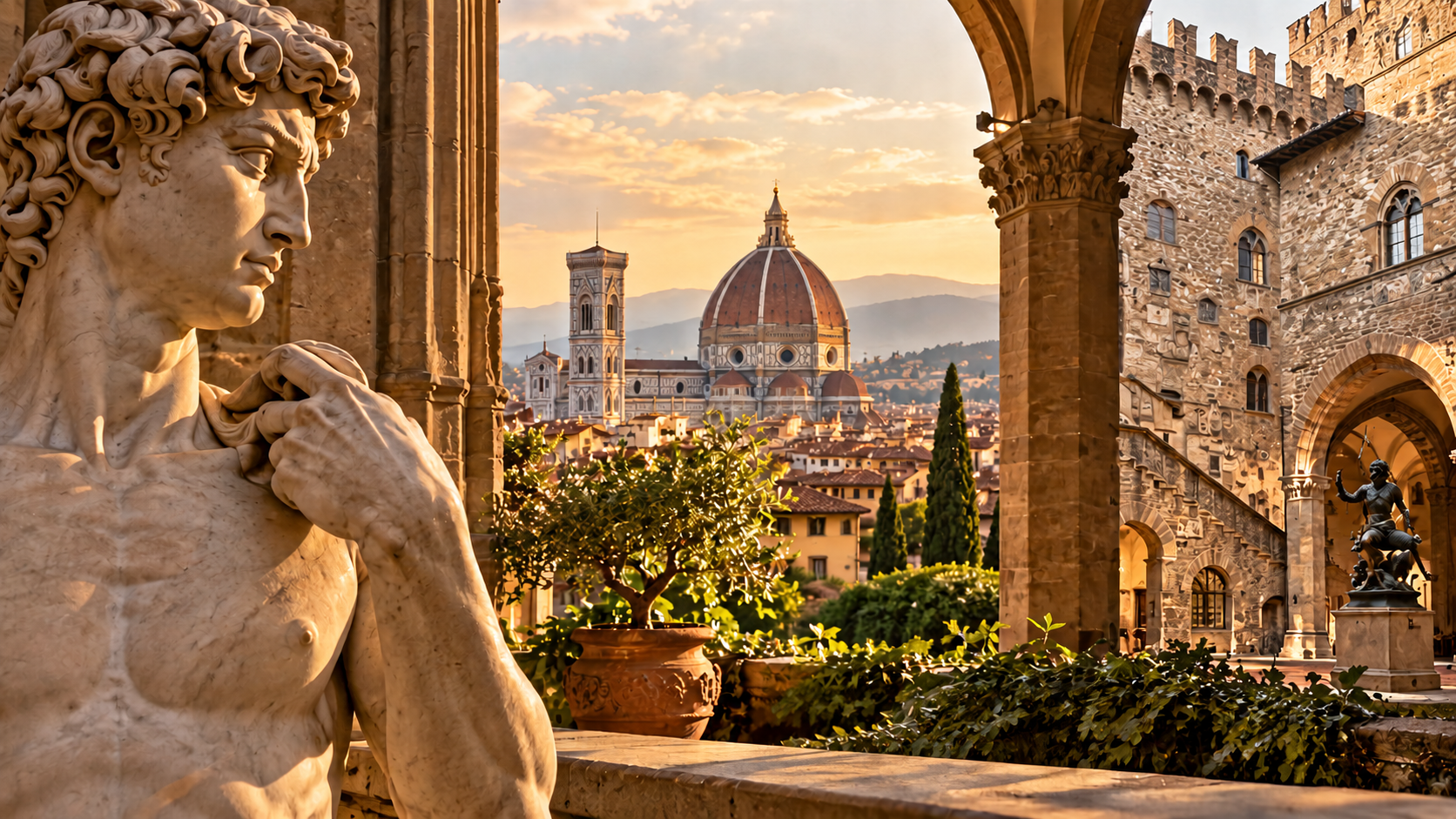
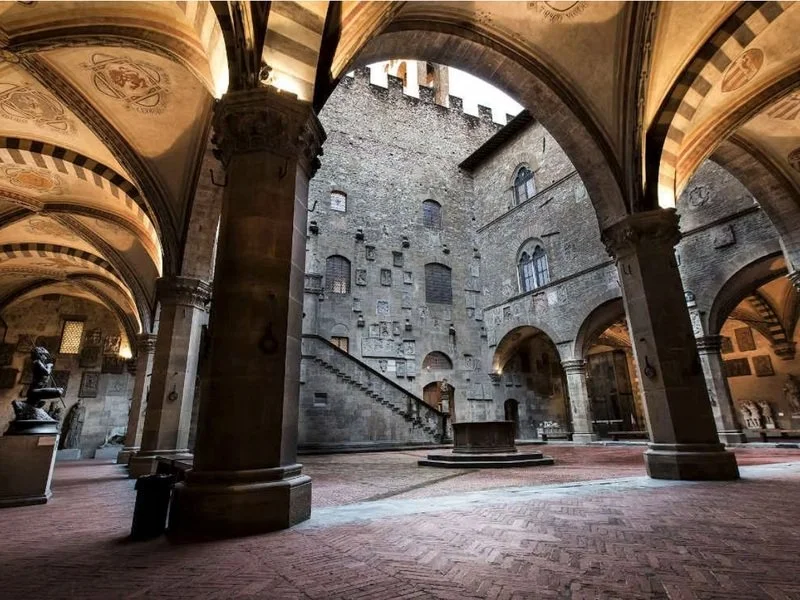
This fortress-like building was once the city’s police headquarters and prison (bargello was the title of the police chief). Today it holds the best collection of Renaissance sculpture in Italy. The star is Donatello’s bronze David, the first freestanding nude statue cast in bronze since ancient times. It’s fun to compare him with Michelangelo’s marble David at the Accademia, carved about 60 years later. Look for Michelangelo’s tipsy Bacchus, too.
Practical Tip: An optional Saturday stop. Tickets are €12, or free with the pass. It’s usually much quieter than the Accademia. Closed Mondays. Official site
Galleria dell’Accademia
Most people come for one reason: David. Michelangelo carved him from a single block of marble between 1501 and 1504, when he was in his twenties, out of a piece other sculptors had given up on. He stands 17 feet tall and lived outside in Piazza della Signoria for nearly 400 years before moving indoors in 1873 to protect him.
On the way in, you’ll pass a hallway lined with Michelangelo’s unfinished Prisoners, figures that look like they’re struggling to break free from the stone. They’re the best glimpse anywhere of how he worked. But since we’re there for the first slot, it’s worth hurrying past them to get a few quiet minutes with David before the crowds arrive. Just be sure to circle back to the Prisoners on your way out.
Practical Tip: We’ll be in line by 7:50 AM for the first 8:15 slot, before the tour groups. Tickets are €20, or covered by the 72-hour pass. Closed Mondays. Official site
Medici Chapels
This is the Medici family’s mausoleum, attached to their parish church of San Lorenzo, and it comes in two very different parts. The Chapel of the Princes is a huge octagon covered floor to ceiling in inlaid marble and semi-precious stone, built to show off the family’s wealth. The New Sacristy is Michelangelo’s design, with his tombs for two Medici dukes and the reclining figures of Night, Day, Dawn, and Dusk.
Practical Tip: A 7 minute walk from the Accademia, so it’s our second stop Friday. Tickets are €11, or covered by the pass. Closed Mondays. Official site
Uffizi Gallery
Uffizi means “offices,” and that’s what this building was: government offices built for Cosimo I de’ Medici in the 1560s. The Medici filled it with art, and today it’s one of the great museums of the world. Botticelli’s Birth of Venus and Primavera are the headliners, along with works by Leonardo da Vinci, Michelangelo, Raphael, and Caravaggio.
Practical Tip: It’s enormous, so a 90 minute highlights tour is the way to go. Tickets are €25 to €29 and not covered by the pass. Book a timed slot. Closed Mondays. Official site
The Duomo Complex
Baptistery
The octagonal Baptistery is one of the oldest buildings in Florence, and Dante was baptized here. Inside, the ceiling glows with gold mosaics. Outside, look for the gilded east doors that Michelangelo supposedly called the “Gates of Paradise.” The ones on the building are copies, and the originals are safe in the Duomo Museum.
Practical Tip: Included in both the Brunelleschi and Giotto passes, along with the Duomo Museum.
Cathedral of Santa Maria del Fiore
The cathedral took nearly 150 years to build. When it was time for the dome, no one knew how to span a gap that wide. Filippo Brunelleschi, a goldsmith by training, won the job and finished it in 1436 using clever techniques he kept secret. It’s still the largest brick dome ever built. The colorful marble front you see today was only added in the 1880s.
Practical Tip: The cathedral itself is free. Shoulders and knees covered. Climbers can go up the dome’s 463 steps (Brunelleschi Pass, €30, timed slot, book early) and walk right past the giant Last Judgment frescoes inside the dome. Official site
Giotto’s Bell Tower
Climb the bell tower instead of the dome and you get the best view of the dome. It’s 414 steps, with a few landings to catch your breath.
Practical Tip: Giotto Pass, €20, no timed slot needed. A good choice if the dome slots sell out.
Squares & Landmarks
Orsanmichele
It looks like a church, but it started as a grain market. Florence’s powerful guilds each paid for a statue of their patron saint for the niches outside, and they competed to hire the best sculptors, including Donatello and Ghiberti. The statues outside are copies. The originals are in the museum upstairs.
Practical Tip: Covered by the 72-hour pass (€10 otherwise). Steps from Piazza della Signoria, so it’s an easy add-on Saturday.
Piazza della Repubblica
This big, open square sits right on top of the ancient Roman forum, the very center of the original Roman town. The column in the square marks the spot. In the 1880s, the city knocked down the old market and Jewish ghetto that stood here to build the grand square you see today, with its triumphal arch and an old-fashioned carousel. Historic cafés like Gilli, open since 1733, line the edges.
Practical Tip: Free and right between the Duomo and Piazza della Signoria. For a great view of the Duomo, ride up to the rooftop café at the Rinascente department store on the square.
Piazza della Signoria
Florence’s main square has been the center of its political life for 700 years. Palazzo Vecchio, the old town hall with its tall tower, still houses the mayor’s office. Next door, the open-air Loggia dei Lanzi is a free sculpture gallery, with Cellini’s Perseus holding up Medusa’s head. Look for the round plaque in the pavement near the Neptune fountain. It marks where the friar Savonarola, who led the “Bonfire of the Vanities,” was executed in 1498.
Practical Tip: Free and open all the time. Part of Ray’s walking tour Thursday, and a good place to start the wine window hunt Saturday.
Piazza San Lorenzo
The Medici’s home turf. The square sits in front of their family church, the Basilica di San Lorenzo, with its rough, unfinished front. Look for the statue of Giovanni delle Bande Nere, a Medici soldier and father of the first Grand Duke. The streets around the square are lined with leather stalls, and the Mercato Centrale food hall is just around the corner.
Practical Tip: We’ll be right here Friday after the Medici Chapels. Browse the stalls, but compare prices and quality before buying.
Piazza Santo Spirito
The heart of the Oltrarno and a true locals’ square. It’s shaded by trees, with a small morning market, cafés, and neighbors chatting on the church steps. The plain cream front belongs to Santo Spirito, the last church Brunelleschi designed. Inside, look for a wooden crucifix that Michelangelo carved when he was only about 17.
Practical Tip: Our Monday morning coffee spot. It’s quiet in the morning and lively at night, when locals gather for an aperitivo.
Ponte Vecchio
The “Old Bridge” dates from 1345 and is lined with tiny shops hanging over the Arno. Goldsmiths have run them since the 1590s, when the Medici evicted the smelly butchers and tanners. Above the shops runs the Vasari Corridor, the Medici’s private covered walkway. In 1944, retreating German troops blew up every other bridge in Florence but spared this one.
Practical Tip: Golden hour Thursday is our moment. For the best photo of the bridge itself, walk one bridge west to Ponte Santa Trinita.
The Great Churches
Basilica di San Lorenzo
The Medici’s parish church, and one of the first Renaissance churches ever built, designed by Brunelleschi. The front was never finished. Michelangelo designed a marble facade, but it was never built, so the rough stone is still bare. Inside, look for Donatello’s bronze pulpits and the Old Sacristy, with its dome painted like the night sky. Donatello and Cosimo the Elder, the founder of the Medici dynasty, are both buried in the crypt.
Practical Tip: €9 covers the basilica, crypt, and Old Sacristy. A combined ticket with Michelangelo’s Laurentian Library and its famous staircase is about €9.50, but the library is open weekday mornings only. Opens around 10 AM and is usually closed to visitors on Sundays, so Friday after the Medici Chapels is perfect.
San Miniato al Monte
High on a hill across the river, this Romanesque church has been here for about a thousand years, and it has the best view in Florence. The monks who live here often sing Gregorian chant at evening vespers.
Practical Tip: Free. Our Monday sunset stop. It’s a 25 to 30 minute uphill walk from Ponte Vecchio, or a short taxi ride. Official site
Santa Croce
The largest Franciscan church in the world is also Florence’s hall of fame. Michelangelo, Galileo, Machiavelli, and the composer Rossini are all buried here. Dante has a grand monument, but his tomb is actually empty, since he died in exile and is buried in Ravenna. In the chapels, look for frescoes by Giotto. The 1966 flood hit this neighborhood hard, so watch for plaques on nearby walls showing how high the water rose.
Practical Tip: Tickets are €10, about 45 minutes. On Sundays it’s afternoon only, 1:00 to 5:00 PM. The Leather School is right behind it. Official site
Santa Maria Novella
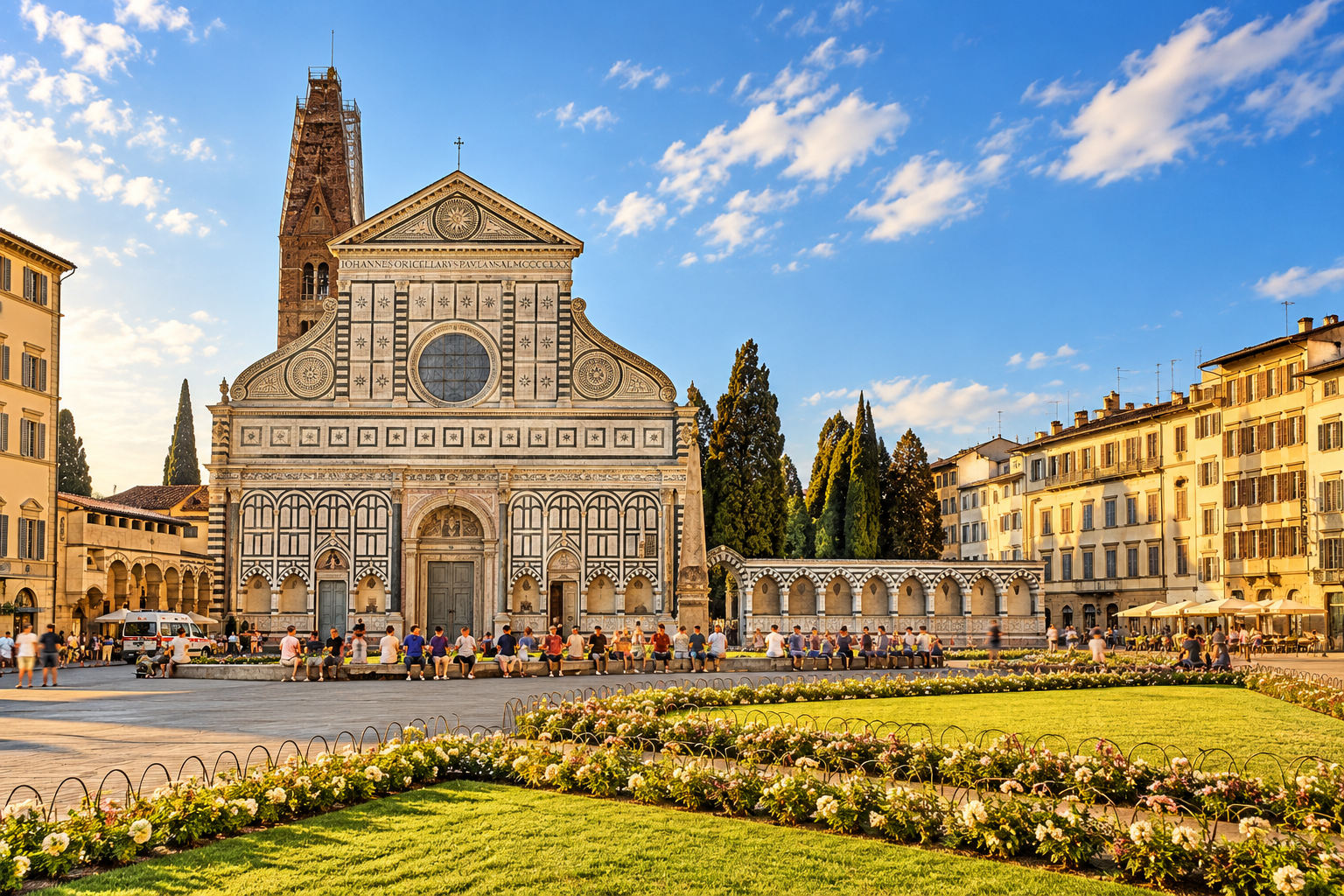
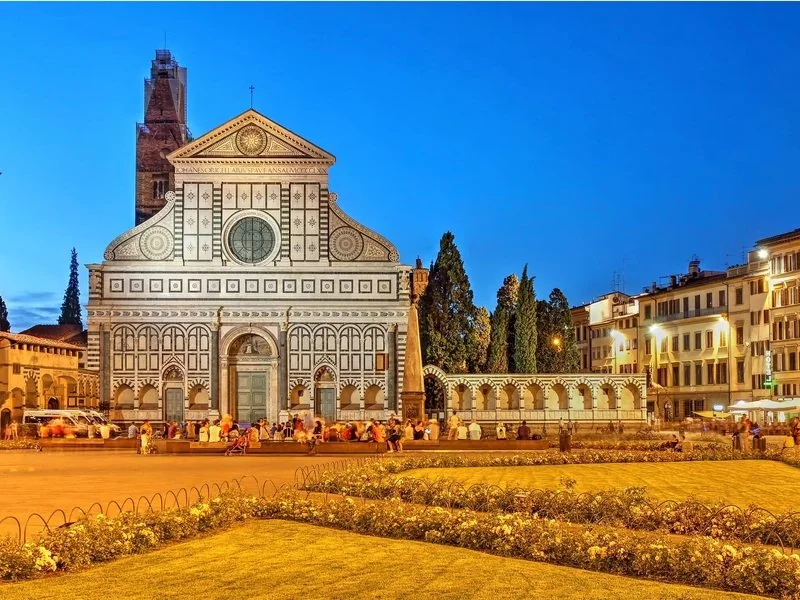
The first church you’ll see coming out of the train station, with its green and white marble front. Inside is Masaccio’s Holy Trinity, painted around 1427 and one of the first paintings to use true perspective. People at the time were amazed that it looked like a hole in the wall. Don’t miss the Ghirlandaio frescoes behind the main altar.
Practical Tip: Tickets are €7.50, about 45 minutes. Sundays 1:00 to 5:00 PM only. Official site
Arrivederci, Italia!
Basilica di Santa Maria Novella